A young woman in Egypt is facing death threats after posting a video showing the face of a man she says repeatedly harassed her, reigniting debate over how victims of sexual harassment are treated in the country.
According to a report by Agence France-Presse (AFP), Mariam Shawky, an actress in her twenties, filmed the man aboard a crowded bus in Cairo earlier this week. In the video, which she posted on TikTok, Shawky alleged that the man had stalked and harassed her multiple times near her workplace.
“This time, he followed me onto the bus,” she said in the clip. Local media later dubbed her the “bus girl.”
The footage shows Shawky confronting the alleged harasser while several male passengers look on without intervening. The man appears to mock her appearance, call her “trash,” question her clothing and move toward her in what seems to be a threatening manner.
No one stepped in to defend her. One passenger holding prayer beads tells her to sit down and be quiet, while another lightly restrains the man but does not speak up in her support.
As the video spread across social media, Shawky initially received some support, but it was quickly overshadowed by a wave of online abuse and threats.
Among those criticized for fuelling the backlash was singer Hassan Shakosh, who suggested she had provoked the incident by wearing a piercing, saying it was “obvious what she was looking for.”
Online comments were even more extreme, with some users issuing death threats and saying no one would mourn her if she were killed.
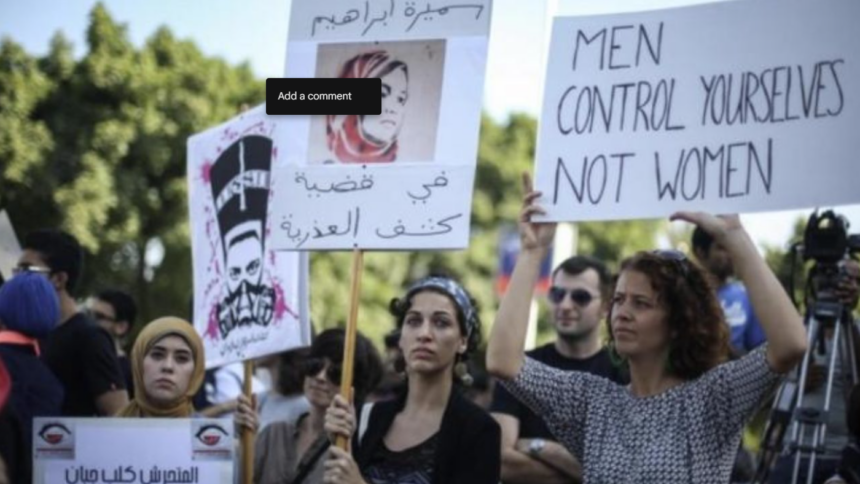
The case has revived a longstanding national debate over harassment and violence against women in Egypt. A 2013 study by the United Nations found that 99.3 percent of Egyptian women reported experiencing harassment, with more than 80 percent saying it occurred regularly on public transport.
Public outrage over sexual violence has flared before, including in 2022 when university student Nayera Ashraf was stabbed to death by a man whose advances she had rejected. The perpetrator was later executed, though some had called for his release at the time.
Prominent feminist activist Nadeen Ashraf, whose social media campaigning helped spark Egypt’s #MeToo movement in 2020, said the latest case highlights what she described as a “systemic and structural problem.”
She said incidents of harassment are often not taken seriously and that blame is frequently shifted onto women’s appearance.
“If a woman is veiled, they’ll say her clothes are tight. If her hair is uncovered, they’ll focus on her hair. Even if she wears a niqab, they’ll say she’s wearing makeup,” she said. “There will always be something.”
Authorities said the man in the video was identified and arrested a day after the footage went viral. However, he denied the harassment and said he had never met Shawky before.
Local media reported he was later released on bail of 1,000 Egyptian pounds (around $20) before being detained again in connection with a separate, pre-existing loan case.
His lawyer has called for Shawky to undergo a psychiatric evaluation, accusing her of damaging Egypt’s reputation by portraying the country as one where harassment is tolerated.— AFP